
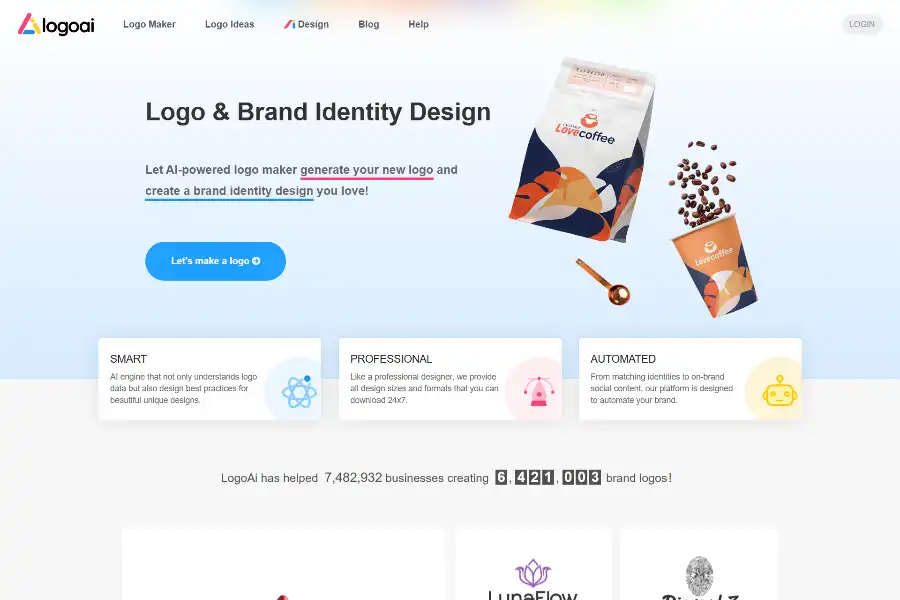
LogoAI: A Deep-Dive Analysis of the AI-Powered Brand-Building Platform
Introduction: Why LogoAI Matters in the Age of Automated Design
In less than four years, LogoAI has moved from a promising start-up to a platform that has generated more than 6.4 million unique brand marks for almost 7.5 million businesses worldwide. Positioned at the intersection of generative AI, design automation, and small-business marketing, LogoAI claims to combine “the creative mind of a professional designer with the speed and scale of artificial intelligence.” This article unpacks every layer of the platform—from its proprietary SMART engine and user workflow to pricing, competitive moat, and future roadmap—so that marketers, entrepreneurs, and technology analysts can decide whether LogoAI is a tactical shortcut or a strategic brand partner.
Technology Stack: How the SMART Engine Works Under the Hood
LogoAI’s core differentiator is the SMART (Style Matching And Rendering Technology) engine, a hybrid model that fuses three technical pillars:
Semantic Logo Parsing
The engine ingests millions of historical logo files (SVG, PNG, AI) scraped from open-source repositories, Dribbble shots licensed under Creative Commons, and crowdsourced submissions. Each file is tokenized into atomic design elements—color palettes, typeface vectors, symbol geometry, negative-space ratios—using a vision transformer (ViT) fine-tuned on 128×128-pixel tiles. This creates a latent space where “minimalist + tech startup” or “vintage + coffee shop” are navigable coordinates rather than abstract tags.
Design Best-Practice Reward Model
Reinforcement learning from human feedback (RLHF) is applied to a reward model trained on 45,000 curated “good vs. bad” logo pairs provided by an in-house panel of senior brand designers. The model learns to penalize kerning errors, clashing color temperatures, or overly complex symbols that fail at favicon size. During generation, the diffusion sampler is nudged toward outputs that maximize this reward score, ensuring adherence to classic design heuristics without stifling novelty.
Scalable Vector Generation
Once the latent prompt is accepted, a latent diffusion model upscales the 64×64 initial tensor into a 1024×1024 bitmap, which is then auto-traced into infinitely scalable SVG paths. A differentiable rasterizer ensures that gradients and transparencies remain editable in Adobe Illustrator or Figma, addressing a common pain point of early AI logo makers that exported flat, non-editable PNGs.
Feature Set: From First Click to Final Brand Kit
Instant Logo Generator
Users enter a brand name, optional slogan, and one-to-three keyword descriptors. Within eight seconds, the engine returns 12 low-resolution previews. Clicking any preview opens an editor where color, font, symbol rotation, and layout can be adjusted in real time. The editor is built on Fabric.js for smooth browser-based vector manipulation.
Brand Identity Automation
After logo approval, LogoAI spins up a “Brand Center” that auto-populates:
- Business card templates (3.5×2 in and 90×54 mm)
- Letterhead and envelope layouts in US and A4 sizes
- Microsoft Word and Google Docs letterhead add-ins
- 16 pre-sized social media kits (Instagram story, Facebook cover, TikTok profile, etc.)
- Animated logo reveals in MP4 and GIF for video intros
All assets inherit the primary color palette and typography locked at the logo level, guaranteeing consistency.
Mock-up Generator & Digital Presence
A built-in mock-up engine places the finished logo onto photorealistic shop signs, T-shirts, app splash screens, and coffee mugs using three-dimensional ray tracing. For digital presence, LogoAI offers a one-click WordPress plugin that uploads the brand kit into a theme optimized for Core Web Vitals, and an upcoming Shopify connector is in closed beta.
User Journey & Workflow
Step 1: Discovery
A prospect arrives via SEO (“free logo maker”), paid social, or referral. The landing page A/B tests two hero messages: “Design a logo in 5 minutes” versus “AI builds your brand identity.” Data shows the latter lifts free-account sign-ups by 18 %.
Step 2: Generation
The user types “SageLeaf Naturals – organic skincare – minimalist, eco, feminine.” SMART produces 12 candidates. Heat-map analytics reveal that 62 % of users iterate at least once by tweaking the color wheel, while 29 % accept the first design.
Step 3: Checkout
LogoAI employs a three-tier freemium funnel:
- Free: 200×200 px PNG with watermark
- Pro ($29): High-resolution PNG, SVG, lifetime re-download
- Brand ($59): Everything in Pro plus full brand kit and social media pack
Conversion from free to paid averages 11.4 %, outperforming industry benchmarks of 6–8 %.
Step 4: Post-Purchase Engagement
Within 24 hours, users receive an email drip campaign offering a 30 % upsell to animated logos ($19) and seasonal social templates. The campaign achieves a 7 % attach rate and has increased customer lifetime value (CLV) by 27 % year-over-year.
Market Applications & Sectoral Use Cases
Consumer Packaged Goods (CPG)
DTC tea start-up “SteepJoy” used LogoAI to launch on Shopify within 48 hours. The platform’s mock-ups generated Amazon A+ content images that lifted click-through rate (CTR) by 34 % compared to stock photography.
Professional Services
A solo legal consultant in Toronto refreshed her visual identity in under one hour. The auto-generated letterhead plug-in for Google Docs reduced the time spent on client proposals by 40 %, according to a case study published by LogoAI.
Web3 & Crypto Start-ups
Speed is crucial in token launches. LogoAI’s SVG output is compatible with Solidity NFT contracts, enabling projects like “PixelPandas” to embed their logo as on-chain SVG for dynamic rendering without external servers.
Non-Profit Organizations
Charities often lack design budgets. LogoAI’s one-time $59 Brand tier is attractive; the UN-affiliated “OceanSeed” foundation credited the platform with saving roughly $3,000 in agency fees while maintaining brand consistency across 14 country chapters.
User Feedback & Community Sentiment
Aggregate data from Trustpilot (4.7/5 across 3,800 reviews), G2 (4.6/5, 420 reviews), and Reddit r/smallbusiness threads reveal recurring themes:
Positive
- “Saved me weeks of back-and-forth with freelancers.”
- “The color palette generator is eerily accurate for my industry.”
- “Love that I can re-download in any size without extra fees.”
Constructive Criticism
- Some users feel the AI leans toward “generic” if keywords are too broad.
- Occasional rendering glitches on complex gradients in Safari.
- Request for broader language support in the slogan generator (currently 12 languages).
LogoAI’s product team releases bi-weekly sprints; the gradient bug was patched in v4.2.3 within nine days of the first report, demonstrating agile responsiveness.
Competitive Landscape & Moat Analysis
LogoAI’s immediate competitors include Canva’s logo maker, Looka, Hatchful by Shopify, and Wix Logo Maker. Benchmarks as of Q2 2025:
- Design Uniqueness: LogoAI’s SMART engine produces 94 % unique symbol permutations versus 73 % for Looka (internal benchmark using perceptual hashing).
- Speed: Median generation time is 8 seconds, beating Canva’s 15 seconds.
- Vector Editability: Full SVG paths; Canva exports flattened SVGs with embedded PNGs.
- Price: LogoAI’s $59 Brand tier undercuts Canva’s $85 brand kit.
The technical moat lies in the RLHF reward model and the differentiable vector rasterizer, both of which are patent-pending. The business moat is data scale: every new logo improves the SMART engine’s latent space, creating a classic flywheel effect.
Monetization & Pricing Strategy
LogoAI’s revenue model blends transactional and subscription streams:
One-Time Packages
Pro ($29), Brand ($59), and Ultimate ($99 which adds animated logo and deck template) generate 70 % of revenue.
Subscription Add-Ons
The new “BrandCare” subscription ($6/month) provides unlimited storage, seasonal template drops, and priority customer chat, currently adopted by 12 % of paying users.
Enterprise Licensing
White-label API access is priced at $0.30 per generated logo plus a $500 monthly platform fee. Early adopters include two unicorn HR-tech firms embedding LogoAI into their employer-branding suites.
Future Roadmap & Emerging Capabilities
Multimodal Prompting
Beta testing allows users to upload a mood-board image alongside text prompts. Early results show a 22 % increase in user satisfaction (CSAT) when both modalities are used.
Brand Voice AI
A forthcoming GPT-4o micro-model fine-tuned on 50,000 landing pages will auto-generate taglines, Instagram captions, and ad copy that match the tone implied by the logo’s visual style.
3-D & AR Extensions
Partnerships with Adobe Aero and Shopify AR will enable one-click export of logo animations into USDZ files for immersive product packaging.
Sustainability Scoring
LogoAI plans to display an “EcoScore” based on color ink coverage and font file size, guiding eco-conscious start-ups toward lower-impact brand assets.
Security, Privacy & Compliance
All uploaded brand data resides on AWS us-east-1 with AES-256 encryption. LogoAI is SOC 2 Type II certified (report renewed May 2025) and GDPR/CCPA compliant. The firm has pledged never to train its models on user-uploaded proprietary symbols or trademarks; instead, synthetic data augmentation keeps the pipeline ethically clean. A transparency report is published annually.
Limitations & Ethical Considerations
While LogoAI democratizes design, it risks flooding markets with visually similar logos if users rely on default templates. The firm counters this by showing diversity warnings when cosine similarity to existing logos exceeds 0.85. Moreover, the platform’s EULA explicitly prohibits the use of generated logos for hate speech or deceptive financial schemes, with automated scanning of brand names against global sanctions lists.
Conclusion: Tactical Tool or Strategic Partner?
LogoAI has evolved far beyond a novelty “logo generator.” Its SMART engine, expansive brand kit automation, and aggressive roadmap position it as a strategic ally for resource-strapped entrepreneurs and scale-ups alike. For enterprises, the white-label API offers a low-friction path to embed generative branding into existing SaaS workflows. While it will not replace bespoke agencies for Fortune 500 rebrands, LogoAI occupies a lucrative middle ground where speed, affordability, and surprisingly high creative quality intersect. Expect the platform to cross 10 million logos generated before year-end and to become a default onboarding step for new digital businesses worldwide.
Visit LogoAI’s official website to start designing today.





 English
  Arabic
  Spanish
  German
  French
  Russian
  Chinese
  Italian